Ferruginous Cangas: pedagogical proposal about the conservation necessity of a threatened ecosystem
DOI:
https://doi.org/10.21713/2358-2332.2016.v13.1011Keywords:
Environmental Education. Canga. Natural Resources. Mining. University-Schools Integration. Textbook.Abstract
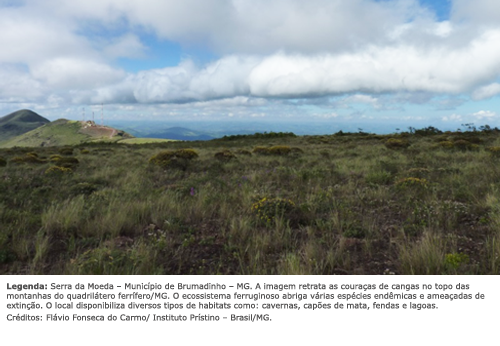
Environmental Education (EE), while an epistemological field, may assist to awake the comprehension of individuals’ role within the environment. In this work, we present the result of a partnership between the Professional Masters Studies in Science Teaching from the Federal University of Ouro Preto and the Prístino Institute, aiming to develop an EE textbook involving the canga ecosystem for teachers and students of the basic education. In Minas Gerais, ferruginous ecosystems – known as “Cangas” – present abiotic characteristics that resulted in one of the environments with higher plant endemism in Brazil. Acting as a water reservoir that supplies water sources of the metropolitan region of Belo Horizonte, the Cangas are on the list of the most endangered ecosystems, especially by mining. This article provides concepts, peculiarities, importance, threats and challenges, in addition to fixation exercises and contextualized discussion being, therefore, a differentiated tool for Science teaching.
Downloads
Published
How to Cite
Issue
Section
License
Authors who publish in this magazine agree to the following terms:
- They hold the copyright on the work and grant the magazine the right of first publication, with the work simultaneously licensed under the Creative Commons Attribution License that allows sharing the work with recognition of authorship and initial publication in this magazine.
- They are authorized to assume additional contracts separately, for non-exclusive distribution of the version of the work published in this magazine, with recognition of authorship and initial publication in this magazine.
- They are allowed and are encouraged to publish and distribute their work online (e.g., in institutional repositories or their personal website), provided that the initial publication in this magazine is mentioned, as this can generate changes.
Furthermore, authors represent that:
- All the information contained in the manuscript are facts, true, or based on empirical or scientific research.
- The use of any trademark or copyright in the manuscript has been credited to its owner or permission to use the name was duly granted.